MeltGL
MeltGL melts images and video in the browser.
Try it
Drop a picture or a video on the box. There is also a page of experiments: the standard test cases used while building the solver, one phenomenon per figure, each running live.
| source | ||
| progress | 0.00 | |
| material | ||
| viscosity | 0.020 | |
| tension | 0.50 | |
| yield | 0.08 | |
| ground | ||
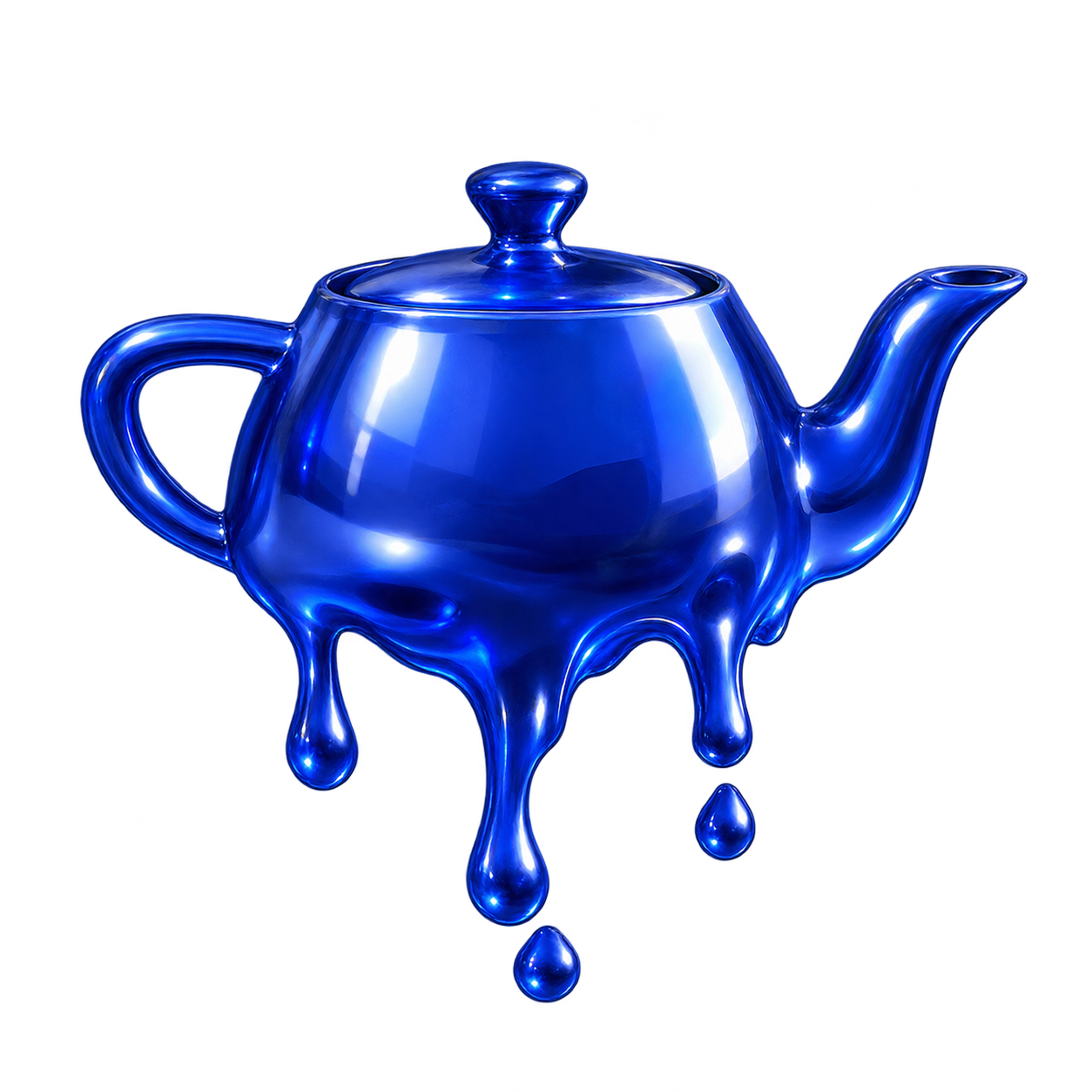
A picture with a transparent or flat background melts as an object, like the teapot. A photo with a busy background is a slab of material with the picture printed on it, and melts like one.
Usage
import { createMelt } from 'meltgl'

const melt = await createMelt({
  target: document.querySelector('#poster'),
  source: 'teapot.png',
  material: 'wax',
  duration: 8
})

melt.play()
melt.on('complete', () => location.href = '/next')
Target is an box; the canvas is placed over it and extends below by dripRoom. The
source is an <img>, a <video>, or a URL to either. A material is a
preset name or a preset with numbers changed, { base: 'honey', viscosity: 1.2, yield: 0.2 }.
layers takes a list of materials, outer first, for a shell over a core. seek,
reverse, configure and dispose do what they say. backend:
'svg' forces the fallback.
Material options
| Field | Range | What it does |
|---|---|---|
| viscosity | 0.001 to 50 | Kinematic viscosity of the liquid, log scale. Molten wax 0.02, honey 2.5, tar 12, solder 0.005. The solid sits four decades above the liquid and creeps. |
| density | 0.1 to 4 | Divides the viscosity, so a dense liquid of the same viscosity runs faster. |
| tension | 0 to 1 | Surface tension. Rounds drops, pinches necks. Higher gives fewer, fatter drips. |
| yield | 0 to 1 | Yield stress. Below it the liquid does not flow at all, so it piles and holds a shape. Chocolate 0.35, honey 0. |
| meltRate | 0.05 to 6 | How fast heat moves through the solid. |
| cooling | 0 to 3 | How fast liquid near the surface loses heat and sets. Wax freezes mid drip, honey does not. |
| gloss, fresnel, refraction | 0 to 1, 0 to 1, 0 to 0.08 | Highlight sharpness, rim brightness, how much the wet surface bends the picture under it. |
| blend, tint | 0 to 1, 4 numbers | How much the liquid takes the material's own colour instead of the picture's, and what that colour is. |
| translucency, absorption | 0 to 1, 3 numbers | How see-through a thin film is, and colour loss per unit thickness per channel. |
Simulation options
| Option | Default | What it does |
|---|---|---|
| duration | 1.6 | Simulated seconds at progress 1. A slow material may not be done by then, which is correct. |
| ground | open | open lets liquid fall out of the bottom. floor is a wall, so liquid lands and spreads into a puddle. |
| simulationScale | 0.4 | Field resolution as a fraction of the canvas. The picture is always drawn at full resolution through the reference map. |
| substeps | 2 | Solver steps per time step. Surface tension strength is limited by the substep, so more allow fatter drops. |
| viscosityIterations | 16 | Jacobi iterations of the implicit viscosity solve. More makes stiff regions stiffer. |
| pressureSolver, pressureCycles | multigrid, 2 | Multigrid V-cycles for the pressure projection. jacobi with pressureIterations is the fallback. |
| stepDuration, snapshotEvery, maxKeyframes | 1/60, 12, 48 | Fixed time step, steps between keyframes for scrubbing, and how many keyframes to hold. A run is repeatable for a seed. When the keyframes are full every other one is dropped and the spacing doubles, so memory is bounded whatever the duration. |
| maxStepsPerFrame | 24 | How many simulation steps one frame may run while catching up to a seek. A jump to the end of a long melt is spread over frames instead of blocking. |
| gravity, drag | 1, 1 | Pull strength, and the wall friction the liquid feels as it runs. |
| heatTop, coreHeat, surfaceHeat, surfaceDepth | 1.2, 0.1, 2, 5 | Extra heat at the top edge, heat reaching the core, heat at the surface, and how many cells deep the surface is. The defaults melt a picture from its edges inward rather than all at once. |
| onsetSpread, columnFeed, noiseScale, seed | 0.6, 0.5, 4, 11 | How unevenly the surface lets go, how much liquid the drip columns are fed, the size of that noise, and which pattern. |
| meltPoint, freezePoint, conduction | 0.5, 0.45, 4 | The temperature solid becomes liquid, the temperature liquid sets again, and how fast heat spreads. Wax freezes mid drip, honey does not. |
| solidViscosity, curvatureFlow, volumeGuard | 40, 0.1, 0.15 | How stiff the unmelted solid is, how much the outline rounds and necks pinch, and how hard the level set is held to its starting volume. |
| rim, edgeWidth, light | 6, 0.6, [-0.35, 0.6, 1] | How many cells the normal takes to turn and face the viewer, how soft the outline is, and the light direction. A zero light vector falls back to the default. |
| dripRoom, topRoom, sideRoom | 0.6, 0.08, 0.15 | Extra canvas below, above and beside the box, as fractions of its size, so the body has air to move into. |
| layerDelay | 0.35 | Seconds each extra layer waits before it starts heating, when layers is set. |
| key | auto | auto keys out a flat background so an opaque picture gets a silhouette. none keeps the whole rectangle. Or a colour and tolerance of your own. |
Credits
MeltGL is a small implementation of ideas from these papers. Wouldn't be possible without them!
- Carlson, Mucha, Van Horn, Turk. Melting and Flowing. SCA 2002. Solids as very high viscosity fluid, viscosity from temperature, implicit viscous step. The model this engine uses.
- Terzopoulos, Platt, Fleischer. Heating and Melting Deformable Models. 1989, 1991. The first melting model in graphics.
- Paiva, Petronetto, Lewiner, Tavares. Particle-based non-Newtonian fluid animation for melting objects, 2006, and Particle-based viscoplastic fluid/solid simulation, 2009. Temperature dependent viscoplastic viscosity.
- Stomakhin, Schroeder, Jiang, Chai, Teran, Selle. Augmented MPM for phase-change and varied materials. SIGGRAPH 2014.
- Batty, Bridson. Accurate Viscous Free Surfaces for Buckling, Coiling, and Rotating Liquids. SCA 2008. Why viscosity must be implicit and what the free surface condition costs.
- Stam. Stable Fluids. SIGGRAPH 1999. Semi-Lagrangian advection and the projection step.
- Sussman, Smereka, Osher. A Level Set Approach for Computing Solutions to Incompressible Two-Phase Flow. JCP 1994. The level set and its reinitialisation.
- Russo, Smereka. A Remark on Computing Distance Functions. JCP 2000. The subcell fix that keeps thin features from eroding.
- Brackbill, Kothe, Zemach. A continuum method for modeling surface tension. JCP 1992. The curvature force on the interface band.
- Papanastasiou. Flows of Materials with Yield. J. Rheology 1987. The regularised yield stress.
- Diez, Kondic. Contact line instabilities of thin liquid films. PRL 2001. Why the thin film model was the wrong one for a melting body.
- Zhu, Quigley, Cong, Solomon, Fedkiw. Codimensional surface tension flow on simplicial complexes. SIGGRAPH 2014. Bergou, Audoly, Vouga, Wardetzky, Grinspun. Discrete viscous threads. SIGGRAPH 2010. Drops, filaments, pinch off.
- Wang, Mucha, Turk. Water Drops on Surfaces. SIGGRAPH 2005. Contact angles, not implemented yet.
- Paulun, Kawabe, Nishida, Fleming. Seeing liquids from static snapshots. Vision Research 2015. van Assen, Barla, Fleming. Visual Features in the Perception of Liquids. Current Biology 2018. Kawabe, Maruya, Fleming, Nishida. Seeing liquids from visual motion. Vision Research 2015. What people actually look at when they judge a liquid, which is why the outline has to move.
- Material numbers: honey viscosity, paraffin viscosity, chocolate Casson yield.
Download
meltgl.min.js (ES module, with source map),
meltgl.js (unminified), or npm install meltgl.
The simulation needs WebGL 2 with EXT_color_buffer_float or
EXT_color_buffer_half_float: Chrome 56, Firefox 51, Safari 15,
Edge 79 and later. Everything else gets the SVG filter path, which is a displacement warp of the source
rather than a simulation, and honours only material, noiseScale,
seed and duration.
git clone https://github.com/1etu/meltgl.git